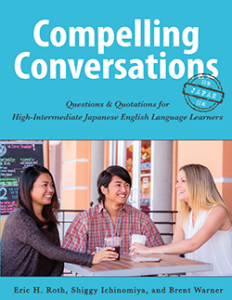
Compelling Conversations for High-Intermediate Japanese English Language Learners
Fact Sheet
Fluency focused
Tackles specific pronunciation challenges for Japanese English language learners
12 Thematic Chapters covering a wide variety of modern and timeless conversation topics
Fosters deep conversation skills
Expands academic and social vocabulary
Over 120 quotes (10 per chapter) and 60+ proverbs designed to improve critical thinking
Contains several Search & Shares to provide more interactive learning
Available for purchase for $24.95 (Amazon)
Publication Date: September 1, 2015
ISBN-13: 978-0-9847985-7-5
eISBN: 978-0-9847985-8-2
Authors: Eric Roth, Shiggy Ichinomiya, and Brent Warner
Buy the Print Edition from Amazon
Table of Contents
Getting the Conversation Started
Going Beyond Hello
Home Sweet Home
Eating and Drinking
Exploring Daily Habits
Being Yourself
Making and Keeping Friends
Sharing Pet Peeves
Taking Photographs
Talking about Movies
Learning in School
Exploring Cities
Appendix
Appendix Chapter
Bibliography
About the Authors
About this Book and the Series
FAQs
Frequently Asked Questions
Compelling Conversations: Japan is an English conversation textbook that invites Japanese learners to speak about real life with greater fluency, confidence, and depth. This book uses open-ended questions, thoughtful quotations, and classroom-tested speaking activities to help students move beyond short, safe answers. The goal is not merely “English practice,” useful as that is. The deeper goal is helping students notice more, remember more, and say more.
This textbook is designed for high intermediate Japanese English language learners, including university students, ambitious high school students, adult learners, and conversation school students. It is especially useful for learners who can already express basic opinions, yet want to sound more natural, reflective, and independent in English.
Students should be able to answer familiar questions, describe personal experiences, and ask simple follow-up questions. For example, a student who can explain a favorite place in Japan, describe a memorable teacher, or compare two holidays is ready to benefit from this book. Perfect grammar is not required. Curiosity helps far more.
This Japan edition gives Japanese learners familiar starting points: school life, family expectations, seasonal traditions, travel, food, friendship, work, and cultural values. From there, students move outward into wider human questions. What makes a good life? What should we remember from the past? How do we keep our individuality in a society that often rewards conformity? This combination makes English conversation feel both local and universal.
The book includes questions about daily life, memories, education, culture, travel, relationships, media, work, values, and the future. A lesson might begin with a simple question about a favorite childhood meal and gradually move toward family traditions, gratitude, or changing Japanese lifestyles. This range gives students room to practice vocabulary, yes, but also judgment, humor, memory, and imagination.
Students build fluency by speaking often, listening closely, and giving fuller answers than they may be used to giving in school English classes. Instead of replying “I agree” and hoping the teacher moves on, students learn to add examples, reasons, memories, and questions of their own. This habit changes the classroom. Conversation becomes less like a test and more like a shared search.
Yes. In classrooms, teachers can use the chapters for pair work, small group discussions, presentations, and writing assignments. In private lessons, tutors can slow down and explore one topic in depth. Independent learners can use the questions for journaling, recording practice, or language exchange meetings. This flexibility matters, since real learning rarely obeys one tidy format.
The questions give students something personal to say. The quotations give them something larger to consider. A proverb, literary line, or historical observation can invite students to agree, disagree, compare Japan with other cultures, or connect the idea to their own lives. This process helps learners practice the language of reflection: “In my experience,” “I partly agree,” “This reminds me of,” and “I see it differently.”
It does both. Students can begin with Japanese experiences, such as club activities, entrance exams, New Year customs, convenience stores, train etiquette, or cherry blossom season. Then they can compare these experiences with other countries, older traditions, and global questions. This movement from home to world is one of the quiet pleasures of good conversation.
Teachers can use a chapter as a full lesson, a warm-up, a discussion circle, a presentation prompt, or a writing assignment. For example, a teacher might start with five partner questions, introduce two quotations for interpretation, ask students to share a personal story, and end with a short reflection paragraph. This structure gives students repeated chances to speak, listen, think, and revise their ideas without turning the class into another worksheet factory.
Students also develop listening, vocabulary, pronunciation awareness, critical thinking, intercultural competence, and confidence. More quietly, they practice paying attention. This skill is underrated. A student who listens well, asks better questions, and notices beauty or contradiction in ordinary life has gained something larger than another memorized phrase.
Teachers, schools, and students can look for Compelling Conversations: Japan through Chimayo Press, CompellingConversations.com, and major online booksellers. Teachers considering classroom adoption can contact Chimayo Press for ordering details, bulk purchases, or course use. This textbook is especially well suited for instructors who believe English class can be more than language drills: a place where students recover curiosity, practice civil conversation, and join the long human exchange across centuries, cultures, and continents.
Subscribe to our newsletter to get news & offer updates.