
Sophisticated English for Global Souls | 1-855-375-2665 · US/Canada 1-310-390-0131 · Outside U.S.
Compelling Conversations
Get In Touch

Compelling Conversations for Fundraisers

Home / ESL/EFL Books / Compelling Conversations for Fundraisers

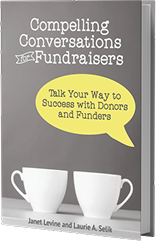
Compelling Conversations for Fundraisers: Talk Your Way to Success with Donors and Funders

Compelling Conversations for Fundraisers: Talk Your Way ot Success with Donors and Funders zooms in on the one-to-one conversations you need to hold with prospects and donors. This essential guide walks you through conversation examples to help you authentically build donor relationships and provides essential strategies for the many different types of donor interactions you’ll face.

Whether you are new to fundraising or a seasoned pro, in a one-person development office or a large university advancement department, Compelling Conversations for Fundraisers provides conversation guidance and helpful tips for the many types of donor interactions you will face and reviews the essentials for meeting prospects and talking your way to success.

Authors: Janet Levine and Laurie A. Selik

Buy the Print Edition from Amazon
Introduction
  • Chapter 1: Values and the Case Statement
  • Chapter 2: Acquiring New Donors
  • Chapter 3: Renewing Donors
  • Chapter 4: Re-Engaging Donors
  • Chapter 5: Upgrading Donors
  • Chapter 6: Planned Gifts, Endowments and Bequests
  • Chapter 7: The Integrated Ask
  • Chapter 8: Foundations and Conversations
  • Resources
What people are saying about Compelling Conversations for Fundraisers

“To make the ask, you need this book, whether you are a new fundraiser or an old hand. Compelling Conversations for Fundraisers provided me, a development professional with 20+ years experience, many fresh ways to approach donors and effectively make the ask.”

Liz Leshin, Director of Development
Los Angeles Conservancy

Compelling Conversations for Fundraisers reminds us that human interests drive philanthropy and encourages fundraisers to weave authenticity through their conversations.”

Natalie Rodriguez Jansorn, Director
College Excellence Program, The Aspen Institute

“Janet and Laurie take the mystery out of asking for money by breaking conversations down to a very easy-to-understand and applicable level.”

Gregory Bradbard>, President & CEO
Inland Empire United Way

“The authors, who each have great experience working for diverse major nonprofits, introduce the reader to many types of campaigns, from approaching current major donors (e.g. board members) to engaging new and re-engaging past donors. Currently, the trend for annual campaigns is to seek ongoing (e.g. monthly, automatic debits) “sustaining” gifts. “Compelling Conversations” also moves ahead with opportunities for upgrading (i.e. increasing the regular amount) contributions and the need on occasion to seek support for special campaigns (e.g. capital building funds). The authors also discuss the sources of funds, such as planned giving of appreciated property (e.g. stocks, bonds real estate, etc.), endowments and bequests. There’s also a section on working with foundation boards and staff (vs. soliciting the donor who set up the fund/foundation).”

Lauren Deutsch
Amazon.com
Learn more about Compelling Conversations for Fundraisers

Check Out Our Other Books!

Download the Chimayo Press Catalog

FAQs

Frequently
Asked
Questions

This confidence-building book helps nonprofit professionals, board members, volunteers, and community leaders hold better conversations with donors and funders. It treats fundraising less like a Hollywood pitch and more like a serious civic conversation: clear, human, prepared, and rooted in shared purpose.

This informative guide is for fundraisers, executive directors, development officers, board members, grant seekers, volunteers, and community advocates. It may be especially useful in Los Angeles, where a single nonprofit professional might speak with foundation officers, entertainment professionals, immigrant families, school leaders, small business owners, and longtime neighborhood donors in the same week.

A.This book favors real conversations over memorized scripts. Scripts can calm nervous speakers, but generous donors usually know when they are hearing a canned performance. Los Angeles has enough auditions already; fundraising conversations need sincerity, preparation, and savvy questions.

This method begins with a simple American truth: people support causes that connect with their values, experiences, and hopes. Better questions help fundraisers learn why a donor cares, whether the cause is literacy, music education, the performing arts, homeless veterans, public health, cleaning beaches, civic education, or improving local schools.

This book helps readers prepare for the ask without turning them into pushy salespeople. A good fundraising request is not a late-night infomercial. It is a clear invitation to help solve a real problem, strengthen a community, or expand an opportunity.

Yes! This resource is especially useful for board members who want to help but dread “asking for money.” Many would rather host a table at a gala, introduce a friend over coffee, or speak at a Rotary Club than make a direct request. This book gives them practical language so they can become confident ambassadors for favorite causes, instead of silent names on letterhead.

Written by two very successful fundraising professionals, this book emphasizes conversation practice rather than theory alone. Many fundraising guides explain cultivation, stewardship, and donor engagement in polished nonprofit language. This guide asks a more practical question: what do you actually say when you meet a donor at a Hollywood Bowl box, school event, an art museum reception, a Chamber of Commerce breakfast, or a backyard fundraiser in Pasadena?

This book includes questions and strategies for speaking with foundations, program officers, sponsors, corporate executives, and institutional funders. These conversations often require a different style: concise, evidence-based, mission-centered, and mercifully free of foggy promises. Los Angeles funders, like funders everywhere, tend to appreciate clarity over inspirational wallpaper.

A.Certainly! This book works well for workshops, staff retreats, board training, and professional development sessions. Each chapter can support paired practice, small-group discussion, role plays, and reflection. This format lets participants rehearse difficult conversations before meeting actual donors, which is usually wiser than improvising over lukewarm coffee at a hotel ballroom. It has also been adopted for graduate courses in fundraising and non-profit management.

Readers will practice active listening, donor-centered questioning, storytelling, follow-up, relationship building, and confident asking. These skills matter whether the conversation happens at a downtown Los Angeles office, a Santa Monica café, a Beverly Hills restaurant, a community college, a church social hall, a public library, or a Zoom meeting with a foundation officer in New York.

Sure. This guide may be especially helpful for small nonprofits where one person often plays several roles: director, fundraiser, grant writer, event planner, social media manager, and occasional chair-stacker. This sometimes stressful reality is familiar across American civic life, from neighborhood arts programs to after-school tutoring groups. This book offers practical tools and focused paths of inquiry rather than another expensive consultant’s pyramid diagram.

This practical book reminds fundraisers that successful development begins with meaningful conversations. Money matters, naturally, but personal relationships usually come first. This approach helps readers talk with potential donors and generous funders in ways that are curious, respectful, specific, and more likely to create lasting support.

“Do not allow anger to poison you.”

— Hopi proverb

Subscribe to our newsletter to get news & offer updates.